A Caseworker’s View of Removals
Author’s note: This is a guest post from a child welfare professional. It is necessary to seek out the perspectives of everyone involved in the foster care system, and to learn a caseworker’s view of removals.

Removals. There are many definitions of the word. Sometimes, removals can be good things; such as the removal of a brain tumor, or a pesky rodent in your crawl space, or the removal of an unwanted weed in your garden. Other removals can be tragic; such as the removal of a parent from the home due to death, or the removal of a pet from a home due to neglect, or of a teenager’s cellphone due to poor grades (tragic to the cellphone-dependent teen).

But what about the removal of children from their homes? Some may say tragic. Others may say good. I would like to share a story about the removal of children from their home, and let you decide. 

I worked a case recently where our office was sent orders to remove youth from an unsafe situation. Upon arriving to the home to carry out the removal of these youth, it was sudden, pure, chaos. Myself and my co-worker arrived at the home with law enforcement where the kids were inside the home, supposedly planning their escape.

Lots of pleading and knocking on the door. Kids were in shock, screaming, crying and shaking uncontrollably. Eventually, we were able to get the kids placed. It was 2:00 am when placement was made. I got back to the office at 3:30 am. All together, the removal and placement of the kids took six hours – basically, an entire night.

The following day was a holiday, so our office was closed. I tossed and turned as I tried to sleep. I kept thinking about how traumatic the experience had been for those youth, and for myself and the other worker. During our 6 hours with them, we were called “monsters”, we “stripped them of any self-respect and dignity” they had, that we take kids for a paycheck, we didn’t care about them, we made their lives a living hell, and that we were useless workers.

Six hours of belittling and degrading. Six hours of holding back tears. Six hours of feeling so sorry for what they were experiencing, that we couldn’t feel sorry for ourselves. We were hungry, tired, and trying to make trauma-informed decisions for youth who could’ve cared less what we felt. 

I laid in bed awake the next day worried sick. From adrenaline rush to total exhaustion, I wondered if they were okay. I thought about them being dropped off with strangers, going to a new school, and how they were visibly shaking walking into their foster home.

I couldn’t sleep. I laid awake for hours thinking about how I could’ve better handled the removal. If I had said enough encouraging words…if I fed them enough…what my next encounter with them would look like. If I felt all of this…. what were they feeling? This is a caseworker’s view of removals.

I drove to work the following day; into the parking lot so slow you would’ve thought it was ice covered. I hesitated to turn my car off. I sat there in the parking lot and cried. I didn’t want to go in. I didn’t want to be a “monster” as those youth had put it. I didn’t want to participate anymore. It was very clear that I had secondary trauma from that removal. Some would give us accolades for removing those youth from a neglectful and abusing home life, but I have some questions to pose. 

What could we as a society do to prevent removals from happening? What could we do to provide proactive services to at-risk families? What could we do to provide supports to youth in crisis? What could we as a society do to assist workers who do have to work with childhood trauma, thus often incurring secondary trauma?

What extensive damage may we unintentionally cause that could possibly be worse than remaining in the natural home with supports? Did we really provide all preventative efforts?

Please pray for these youth, and any other youth who are at-risk. Please pray for workers who have to work with these families on the daily basis who see and hear more than one could typically stomach. Please pray that doctor, juvenile officers and law enforcement officers can see the whole picture and the lasting impact that may come from signing those papers.

A caseworker’s view of removals is often heartbreaking, and I ask that you please pray for guidance on how you might help this broken system. 

This Journey We Are On

There are a lot of worries about this parenting gig. Raising kiddos who are neurologically different offers me multiple moments of worry. I know I’m not supposed to worry. I know that the Lord who knit them in their biological mothers’ wombs has already weaved the tapestry of their lives. I need to trust more; to trust this journey we are on.

Scrolling through some old pictures today, I came across this one taken by my friends at Freedom Photography back in 2013 (before the adoption of our youngest son & when I went through a dark-chocolate dyed hair phase – ha!). Looking at my kids’ tiny little faces with their scrunchy, sweet smiles greets me with great joy.

The statement on the chalkboards sends a ripple through my heart. We weren’t together at birth, but our journeys began together on those days; those laborious, wonderful moments. Those moments belong to their biological mothers. They always will.

If everything we experience is easy, I doubt we could call it a journey. Perhaps, we are meant to stumble a bit along the way so that we can learn how to rise after a fall. Or, maybe, we are meant to mess it all up so that we can know what it is to receive and offer grace. It might be that our hearts are meant to be torn apart so that we can know what it feels like when they are made whole. Maybe, the best part of the journey isn’t so much the final destination, but all the bumps, bruises, and tenderness in between.

I’m not perfect. I won’t ever be all I need to be for my children or my husband. I struggled today and probably will tomorrow. And, do you know what? That is okay. It’s going to be okay.

Pieced together by many little parts of the story – some joyful, some devastating. We are travelers in this journey, each with our own part to play.

My mom always reminds, “The right thing to do is never the easiest.”

And, goodness, this journey we are on isn’t easy, but it is so right. 

Podcast Interview and Thankfulness

Hey friends – Just a little note about a recent podcast interview and thankfulness.

It was 1983 when the words infertility/not being able to ever give birth first became a part of my vocabulary. People just didn’t talk about it, then. Not.At.All. To think of women (and men) throughout centuries who suffered in silence makes me ever-so-thankful for where we are now when it comes to this topic. We still have a long way to go for it to be understood, but we have made significant progress.

Recently, I had so much fun on a podcast called: Foster Care – An Unparalleled Journey. You can listen to my interview by clicking here.

As an adolescent, I knew that I had a lot to say about it but also wanted to keep it hidden out of shame. I thought, “maybe one day, I will write a book”, but it was a burden to carry, becoming heavier as each year passed. When given the opportunity to tell it now or write about it, I still feel a measure of the pain unpeel itself from me – even after all of these years.

Reminded of what the Lord can do with hardship. The Enemy can’t stand for us to be free of the things that were meant to bring us suffering. He would rather us live in misery, sticking to the labels we often give ourselves.

Keep speaking of those things. Keep walking in faith. Keep believing. YOUR story matters.

I also just want to say a big, “THANK YOU” for those of you who have reached out or have read my posts. Your kindness truly means so much.

The 11-yr-old girl I used to be would not believe how far we’ve come; how far she has come. She would be thrilled and dance with joy.

She would also be so encouraged and thankful for you.

Just a Little Longer, Baby

“Just a little longer baby” This thought has been a recurrent one in my mind as my oldest on approaches adulthood. After watching a him singing a song he made (around age 4 or so), I looked at my husband, started crying and said, “I miss this. I miss the little boy he used to be. It goes by so fast.”

We put a lot of emphasis on celebrating and grieving our “last babies”. I get it. I really do. But, oh man, there is something about watching our first babies grow up. It is a slow process of grief and yet, it seemingly happens overnight.

One day, your first baby is stacking blocks to his own amusement. Laughing at all the silly jokes. Crawling into your arms. Asking to be held. In the tiny, sweet voice, you hear, “Just a little longer, Mommy”.

And then, that little boy is gone. That voice is gone. All the silly jokes are gone. The amusement at stacking blocks is gone. Time is cruel. It steals from us – carries pieces of our hearts away. You look at your first baby and think, “Just a little longer, baby.”

I used to cringe when people would tell me that “it goes by fast”. It’s easy to get annoyed by this because you are just so darn tired and busy. I also used to wonder why elder women (and men) would stare at my babies, grinning to themselves, and giggle a bit. I know now. They were going back in their minds to when their babies were young; visiting a place from long ago, a tourist in a land they cannot stay in.

And now, I’m there. I’m a tourist walking through the land of memories of my first baby. We are getting closer to him becoming an adult. Gulp. In the blink of an eye, he went from being that curly-haired, goofy little dude to a teenager just five years removed from adulthood.

It isn’t fair. It doesn’t feel good. Sometimes, I feel that my heart just can’t take it. I don’t like being this kind of tourist. I don’t want to just visit that place from long ago. I’d rather move back there and do it all over again.

Just a little longer, baby.

Just a little longer.

a hope for the future

Have you ever met a kiddo without a hope for the future? I have. After having been in foster care for several years, a 12-yr-old boy was assigned to my caseload. One day, I asked him, “What do you want to be when you grow up?” He looked me straight in the eyes, shrugged his shoulders and said, “Eh…I figure I’ll either be in jail or dead by the age of twenty-one, so does it really matter?”

Speechless. It took me a moment to gather my thoughts.

“Don’t put that out there! There are all kinds of things to be and do when you grow up!” (I said this to encourage him but to no avail.) Shrugging his shoulders again, he said, “Well, it’s probably true.” Conversation ended.

Years later, I found out that after he aged out of foster care (because he was never able to be matched with a family), he ended up committing a non-violent crime and was sentenced to prison…right around the age of twenty-one. I have no idea if he is out or not, but even after all of these years, I wonder if he ever found his place, or better yet, found himself, in this world.

Trauma defined his life and identity. It filled in the lines between his growing years. It slapped a label on him that was nearly impossible to peel off. Had he been able to connect with one consistent adult (other than child welfare professionals), would his life have turned out different?

YES. I ABSOLUTELY BELIEVE SO.

How can we, as a society, help kids like him?

We need:

  • Families interested in fostering kids over the age of twelve, including sibling groups with mixed ages.
  • More funding for programs designed to target at-risk youth and provide them life skills, opportunities to explore jobs and support.
  • Trauma-informed base of knowledge into any program, school or other sites who provide care, in any capacity, to youth.
  • Churches to educate themselves and get engaged with systems that might make them uncomfortable. (Jesus doesn’t ask us to be comfortable, anyway. Can I get an ‘Amen’?!)
  • Purpose-driven resourcing for at-risk youth. Meaning, behind every action that is taken with this population, make sure there is a purpose that will drive them towards a better future.
  • Mentors!! We absolutely need adults to step up and seek out ways to get involved. I’m not going to lie. It isn’t pretty all of the time and you may not think you are making a difference, but every small action can lead to big leaps for these kids.

If there isn’t a mentoring program in your community, find out how you can start one. Talk with various agencies who work with at-risk kids and ones in foster care. Consider if your small group at church could provide support. Speak to your schools about what they might need. I am a firm believer that when at-risk youth (in or out of foster care) find connection with at least one adult, their chances of success greatly improve.

Kids deserve to have a hope for the future. We can help get them there. I believe that!

Life Lesson: Apples to Apples

In continuing life lessons for my kids, I decided to focus on loneliness. For fun, I’m calling my lessons, “Tuesday Night Teachings“. They look forward to Tuesday nights and ask, “Are we going to have a Tuesday Night Teaching?” This one is called, “Life Lesson: Apples to Apples”.

We sat around the dinner table and took turns telling each other what we are thankful for. It was a pleasant sound to this mom’s ears to hear my kids talk about being thankful for people in their lives, including our family.

This conversation about being thankful for each other was a perfect lead-in to tonight’s lesson.

“Don’t leave the table just yet. I want to talk to you. I saw something on Facebook that made me really sad. A guy lost his pet cat and asked for help finding it. He said it was the only thing left in his life. It made me cry for him because he later found that his cat had gotten hit by a car. I thought about how lonely he must be without his pet – especially because he said that his cat was really the only thing left in his life.

There are a lot of lonely people in the world.”

Passing the bowl of apples around, I asked each person (including myself and husband) to pick the one that is the most appealing to them. There were six different apples in the bowl. Each of us grabbed the one that we wanted and then took turns telling why we picked that apple.

“Now let’s all take a bite of our apples.”

The kids giggled a bit. My oldest son joked about thinking he might have swallowed a part of the core.

Lining the apples up next to each other, I said,

“Look at that. They are all so different on the outside, but look at the inside. They are the same. People are a lot like apples. God created us to be unique in our skin color and size. We each have our own ‘flavor’ but on the inside we are the same.

Do you notice that there is one apple that wasn’t picked? That is how some people feel. For instance, some people are left out because of the way they look or the color of their skin or for other reasons. On the inside, they are just like you and me.”

I ended the lesson by talking with my kids about how loneliness is a big problem in our world but if we can get past what is on the outside of a person and look at the inside, maybe we can help each other not be so lonely.

I’m really hopeful that each little nugget of wisdom about God’s truth seeps into their pores; creating a future filled with a genuine love of others. God doesn’t ask us to necessarily like everyone but he does ask us to love one another.

This God-kind-of-love sets the lonely into families.
It sees us from the inside out.
This God-kind-of-love can change generations.

I believe that.

John 15:12: “My command is this: Love each other as I have loved you.”

(Life Lesson: Apples to Apples – what other ways have you used to teach children about loneliness?)

a broken girl

Sitting across from her, our eyes met. A broken girl. One with potential, but a past so heavy that it weighed her down. Familiar pain, with a hint of resistance filtered the air. Soon, tears, rich with sorrow, rolled down her cheeks. Have you ever felt grief? I don’t mean going through the emotions of it, but actually feeling it as it permeates the air? It was our companion on that day; a bitter, suffocating ghost of what should have been.

Inhale. Exhale. Deep breath. I said, “Okay. We need to discuss what happens from here. The case is coming up very soon for permanency so the Judge will want to know what we are going to recommend.” As her case manager, I had worked with her for over nine months. We both desperately wanted success. She loved her baby, that was never in question.

“Where you are at right now and the way the case is going, I believe the team is going to ask the Judge to change the goal to adoption.” She nodded, then said, “I know. It’s what’s best for him and I want that. I can’t do this. I can’t parent. I love him so much but he deserves more.”

Tears tried to push their way down my cheeks, but I held them back. Not now. I had to remain professional. A broken girl she was but in that moment, her resilience shone bright. “Okay, let’s talk about the type of family you would want for him.”

Pausing for a moment, our eyes met again, “I trust you to pick them. I’d like for him to have a dad and a mom, ones that will always treat him like he deserves to be treated…to love him.”

Before I could get another word out, she lost it. Her body collapsed a bit. She tried to wipe away the tears but she couldn’t. They were her messengers of grief being released into the world. “Caroline, thank you. You have been so kind to me and treated me better than anyone ever has in my life, including my own family.”

This was almost too much for me to take in. Gut-punch. Twinge of ache in my heart. As her case manager, I played a huge role in determining her fitness to be a parent. The termination of parental rights summary would be penned by my hands. I would testify to it, search for an adoptive family and eventually place her little boy there.

“Oh, you’re welcome. I’ve really enjoyed working with you and wish things would’ve turned out different. I want you to get help. You deserve a better life.”

Wiping away tears, she reached out for a hug. I gave her a long one; perhaps, the most genuine one she ever had. We said our good-bye’s and she left. I never saw her again but held onto her words as I searched for and placed her precious son with a loving family who lived out her hopes for her son.

The system failed her. Her parents failed her. Perhaps, in many ways, I failed her. This world did, as well. Trauma. Addiction. Homelessness. Chaos. These things were her constant companions since childhood; the only way of life that she had ever lived. Even as an adult, her companions never left her side. Always there. Like an unwanted shadow.

It is easy for us to look at people like her and question why they just don’t work hard enough to get their kids back. Would we be capable of doing so? How would we feel if trauma was our only childhood friend? What if addiction slithered its way into our soul? Or, homelessness and chaos walked alongside us throughout our lives? Could we manage? Would we?

I think of her, often; that broken girl whose life symbolizes sadness. Did she ever receive help? Is she is out there alone fighting her demons? Will trauma, addiction, homelessness and chaos remain her constant companions?

Years ago, a broken girl sat in front of me. In many ways, she never left.

Seasons of Change (Life Lesson)

A few months ago, I started weekly lessons with my kids on Tuesday nights. Although I’ve taken a break for the holidays, I plan on returning to “Tuesday Night Teachings” after the new year. My kids really seem to enjoy them! Here is one lesson that I taught called, “Seasons of Change”.

I started off by reading Ecclesiastes 3:1-8 to my kids.

There is a time for everything, and a season for every activity under the heavens:
a time to be born and a time to die,
a time to plant and a time to uproot,
a time to kill and a time to heal,
a time to tear down and a time to build,
a time to weep and a time to laugh,
a time to mourn and a time to dance,
a time to scatter stones and a time to gather them,
a time to embrace and a time to refrain from embracing,
a time to search and a time to give up,
a time to keep and a time to throw away,
a time to tear and a time to mend,
a time to be silent and a time to speak,
a time to love and a time to hate,
a time for war and a time for peace.

Looking towards my children, I said, “Dad and I have been talking a lot about how much we’ve changed since we were younger.”

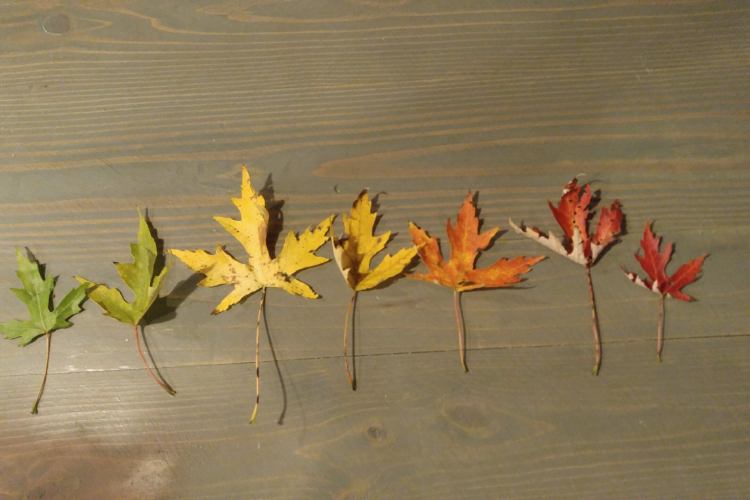
One-by-one, I placed the leaves on the table and asked, “What is this?” Each time I pointed to one, they said, “a leaf”.

“Yes, and look at how much the leaves have changed. In life, you will go through a lot of seasons and changes. There will be some days that you feel ‘green’ and happy and other days where you may feel ‘yellow’ or sad. Sometimes, you feel ‘red’ or angry about things going on. Just like these leaves, you will change and go through different times in your lives.

Do you notice that even though a leaf started off green, it ended up red, and even though it went through this season of change, it is still a leaf?” Nodding their heads in agreement, “Yes!”, they said.

“The cool thing is that even though there are changes, the leaf is still exactly what God designed it to be. YOU are as well. Regardless of what you go through or how you change, you were born a child of God and you will always be a child of God.”

Ending the lesson, I explained that this is one of the most important things to remember in life. The only constant is God. When everything else around us changes or when we go through different seasons, God remains the same.

If there is one thing I can hope to teach my children, it is this:

Regardless of what experiences they endure or the seasons of change they go through, I truly desire for them to know just how deeply they are loved by God, how they were created with a purpose, and that they will always be one of His kids.

Ramen Noodles and Trauma

A few days ago, I shared a story on my blog Facebook page (@barrentoblessed) about ramen noodles and trauma. Yes, ramen noodles and trauma. My cousin is a foster parent who recently adopted four siblings. She and her husband are also fostering the fifth sibling.

Here is the post as written by my cousin:

“Tonight, after 2.5 years of living here, my oldest son sat down at the table with this. He was about to chow down when I stopped him and asked what in the world he was doing.

He said, “I made myself dinner.”

“But it isn’t cooked. I can cook that you know.”

“Well, I wanted to eat something I used to eat a lot with my old family.”

So we sat down and I asked him to tell me about it. He said that they wouldn’t feed him due to being passed out (you can guess why) and he would have to make dinner for himself and his brothers (2 and 4 months when they came to us). He said that all the money they had would be spent on cigarettes and other fun things and so he would find change in their van and would buy Ramen packets at the store down the street (at 6!!!!).

He said he didn’t know how to boil water, so he would eat it like this. And, he actually grew to like it. So, he would break it up for his sibling, and would try to make bottles for the baby (at 6!!!!!!).

Guys. I asked him to make me some. And, I sat there beside him and crunched it down with lots of water because it’s not great…and he just started talking about how the first time I made them ramen, he wouldn’t eat it and I told him I remembered. He said it’s because it reminded him of his ramen packets and he didn’t trust me (big thoughts for 9!).

He said he isn’t sad he’s not with his “old family” (his words) anymore, but that sometimes HE LIKES TO REMEMBER HOW STRONG HE HAD TO BE.

I write this so everyone knows, trauma isn’t healed quickly (sometimes never), an adoption doesn’t erase the past or the memories, kids can change, they will change with love, and to never give up on a kid because “they are hard”. And then, I walked away in shock, in sadness, and so so so proud of how strong my baby is. He’s so wonderful. And, we love him so much.”

I ended it by saying this:

“Friends, THIS is the life experience of kids who come from hard places. THIS is living a trauma-informed life. We can’t imagine what kids from hard places have lived through. It is not just about one act of abuse or neglect, it is about living in survival mode and doing it day in and day out. It is about making sure younger siblings are also surviving, even at the expense of childhood.

Trauma infuses itself into every pore. Kids just don’t forget it. Their brains and bodies won’t let them. Those of us privileged enough (yes, I said privileged) to enter into the lives of children with hard life experiences must be willing to sit down, eat uncooked ramen noodles and listen. We must not give up.

Our kids didn’t.”

Something about this post shook people up. Before I knew it, the post took off and soon became viral – with a reach close to 18 million people, over 9,000 comments and over 160,000 shares. Good Morning America featured it on their website.

People were sharing their own stories of trauma, eating ramen noodles as children, and their experience with foster parenting kids who come from hard places. Overwhelmed. Surprised. Shocked by it all. I felt all emotions in just a short span of time.

Childhood trauma adversely affects children over a span of their lifetime. Trauma doesn’t happen overnight. It isn’t healed overnight. The more we listen to children, seek to understand their stories, and connect with them in a loving way, the better they WILL heal from trauma. I believe that and science proves it.

Was it kind of neat having a “viral” post? Yes. Thrilling to be featured by Good Morning America? Absolutely.

Do you want to know what really stirred my heart, though?

Witnessing love pouring out. Reading thoughts of people seeking to understand trauma. People sharing kindness, hope and prayers for children as well as foster families.

Imagine it – a world where hurting children are met by embracing love; where every child can call home a safe space.

Just picture it. I do. This is my hope. This is my prayer.

on this day of thankfulness

On this day of thankfulness, my childhood has been on my mind. Maybe, it is because my daughter is now the age I was when I had my hysterectomy. Sometimes, I see myself in her. Curious. Strong-willed. Lover of fluffy things. Empathetic. Other times, I don’t.

Barrenness rushed in like a thief in the night. It didn’t just steal from me at that time, in that present moment. It kept stealing each and every day as I grew up. A stalker. A shadow that didn’t go away. A reminder of what was missing.

On this day of thankfulness, I’m reminded of the power of restoration. That somehow, grace had the audacity to chase me down, prove me wrong and breathe love and life into my soul.

Thankful for a loving Heavenly Father who took my physical, emotional and spiritual brokenness and flipped the script.

Lightness out of darkness.

Fruitfulness out of barrenness.

Gratitude replacing grief.

On this day of thankfulness, I am truly blessed.